PROCESSING
Thanks to the internet these days we are privy to a lot more information than we used to be. With the stroke of a few keys we can research almost any topic and receive a myriad of information. Deciphering this information can often be tricky as there are no real guidelines as to what can and cannot be posted online.
A topic close to our heart is Bamboo and we know there is a lot of misleading and even incorrect information out there about this topic.
Is it really eco-friendly?
Is it Sustainable?
Why is it hypo-allergenic?
How can it be anti-bacterial?
Below is some information that we’ve collated about Bamboo in general but more importantly, information specific to the processing certification standards that we employ.
The health and care of our customers, mothers and their babies is our number one priority and in saying that, so too is sustainability and transparency. At Lyn’s Label, we are proud of the fact that our processing and manufacturing partners have all the necessary up to date, world-recognized certifications ensuring the fabrics we use are what we say they are. We pride ourselves on providing the safest, high-quality products for mothers and their baby’s and in addition to our standard monitoring and measuring practices it is these globally recognized bodies that provide the certifications to support our ethos of being eco-friendly, safe and PURE.
Our Bamboo Processing Standards
As Bamboo is not cultivated in Australia for the Australian textile industry, we have established a long-term, trusting relationship with a partnering processing and textile facility in China. All of our bamboo fabrics are processes exclusively by this one factory and together we ensure the highest quality and sustainability standards are met.
Our fabric facility and all of their sub-contractors are regularly inspected and assessed, and they all comply with the Organic Content Standard (OCS). Our fabric facility has a current OCS certification.
What does the Organic Content Standard certification mean?
The facility we use exclusively for our bamboo fabric production is following all the internationally recognized organic standards that are currently in place from (OCS). Our Facility Operations Manager conducts monthly research to see if anything else exists that is better or cleaner than what we’re currently doing and we can confidently say there is nothing, we are employing the best methods available.
The yarns that we are using in our bamboo fabrics have been inspected and passed certified Global Organic Textile Standard (GOTS) and our facility has the relevant certifications to support this.
Our fabrics also have passed all testing according to CPSIA and we have the certification for OEKO testing for harmful chemicals and in essence, we do not use any harmful chemicals. The results of the testing made according to Oeko-Tex Standard 100, product CLASS 1 for baby articles and have shown that our goods meet human-ecological requirements that are presently established. We also have a current OEKO-TEX for 2016.
About Bamboo
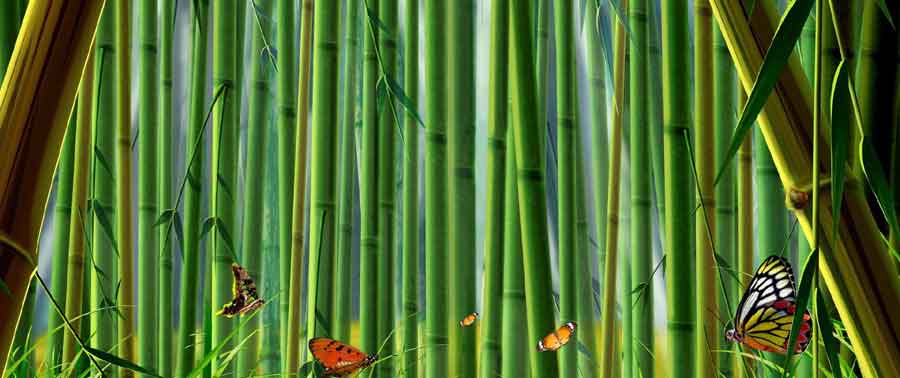
In China, as elsewhere in the world where bamboo is cultivated, bamboo forms a very dense root mat. Bamboo does not have a tap root like trees but has a root mass like other grasses. Bamboo is also partly deciduous with a lot of leaf and culm sheath drop and subsequent rejuvenation. Therefore the bamboo forest floor is constantly covered with a thick cover of leaf mulch which, in turn, breaks down and naturally composts the soil. During heavy rain, any runoff water is quite clear and clean, even on steep mountainsides, bearing testament to an almost complete lack of erosion. Many of the bamboo forests have been there for hundreds of years without any need to replant them as they naturally constantly regenerate themselves with new shoots every year, even with regular harvesting of mature timber.
In China, the bamboo forests are largely very well managed according to a well-founded agronomic practice, even those on remote mountainsides. Every year, every new culm is marked with its year of emergence so that it can subsequently be harvested in the right year to yield timber of the best possible quality.
Bamboo yarns and textiles are produced without the use of dangerous toxic chemicals and no polluting residues remain in the cloth when it finally wears out and is discarded. It comes from nature and is returned to nature in a smooth natural cycle. It has been grown and husbanded for thousands of years and can continue to be husbanded for many more thousand years without environmental degradation. This is what is meant by complete sustainability. Very few crops can make this claim.
Location
Balmoral, 4171, QLD,
AUSTRALIA By Appointment
Phone
0410860883
Business & Company No.
ABN: 83 164 629 841
ACN: 164 629 841
Contact Person
Marnie Newlove